Blog

  • Man’s immortal pursuit becomes a sport

    Man’s immortal pursuit becomes a sport

    ‘Know from whence you came. If you know whence you came, there are absolutely no limitations to where you can go.’

    – James Baldwin: African-American novelist, essayist, playwright, poet, and social critic.

    You are so lucky to be flying at this time in history

    You are incredibly lucky to be a pilot at this moment in time – and, according to our ancestors, the only true pilots. For hundreds of thousands of years our ancestors looked to the birds and dreamt of flight. Whilst our ancestors were hunting and gathering on foot, carrying the fruit of their labor high over mountain passes and defending themselves from wild animals they were watching their feathered friends effortlessly pass over the same mountains. We wanted to be free from the burden of gravity just like them.

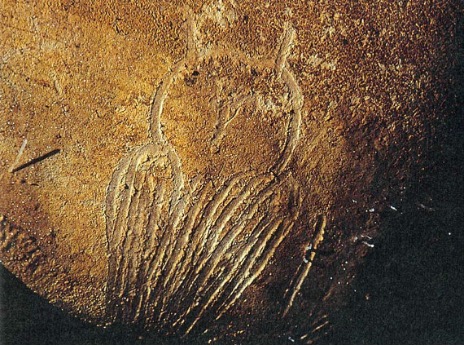
    • We envied them so much we idolised them as gods. As far back as 32,000BC in Chauvet-Pont-d’Arc Cave, France our ancestors were painting them. Horus in Ancient Egypt, Zeus in Ancient Greece, Garuda in Hindu Mythology and many more were all examples of ancient man worshipping these beings that seemed to defy the physics that bound man to the earth.
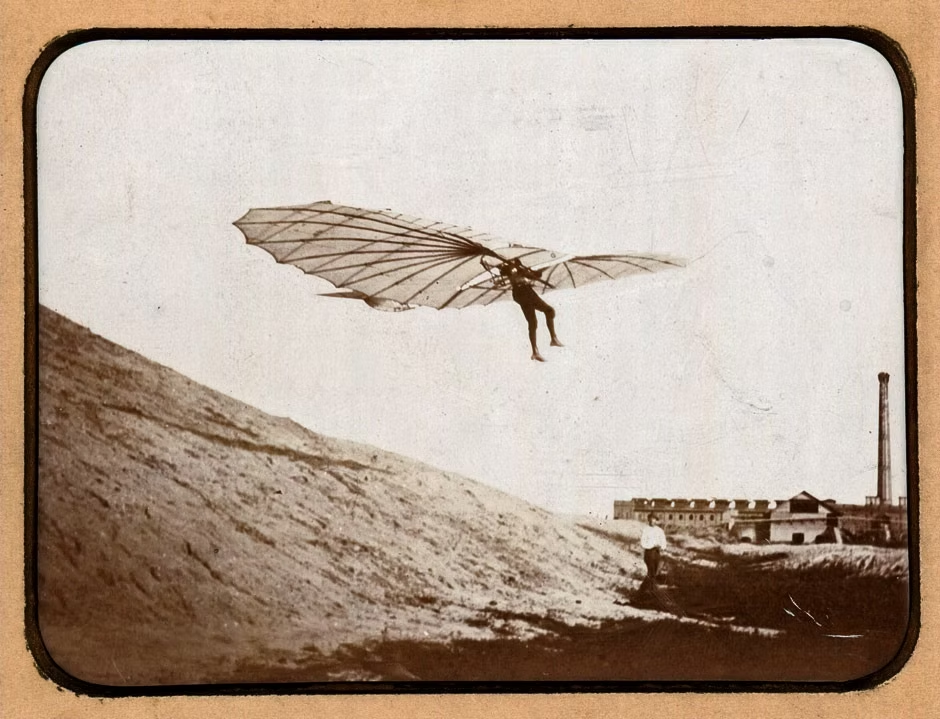
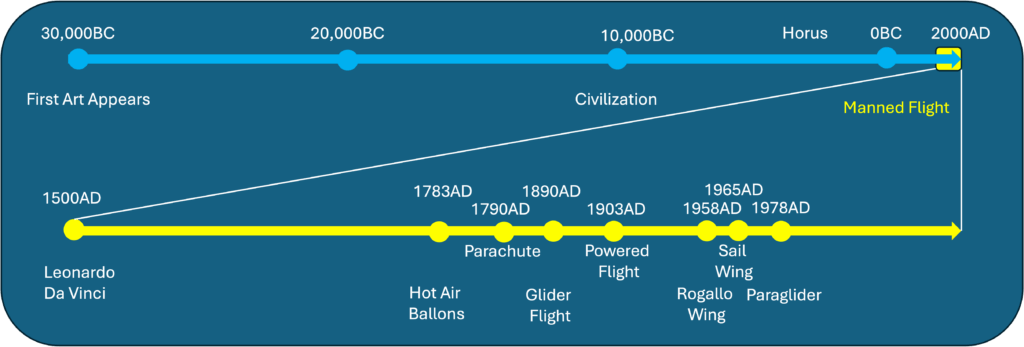
    • And then we decided we would become them. Leonardo Da Vinci in the 15th century, the Montgolfier brothers’ hot air ballons of 1783 and Otto Lilienthal of the 1890s all had a dream to match our avine friends. Then two bicycle mechanics Orville and Wilbur Wright from Kittyhawk USA would defy all the academics and create the first powered aircraft. Wilbur’s last flight was aboard a Lockheed Constellation – the world’s first 80 seat airliner. He saw the first powered flight through all the innovation of WW2 right up to commercial air travel. Subsequently we have continued to develop aircraft right up to the 575 tonne Airbus A380 with up to 800 seats.
    • The development of aviation has really only come in the last 120 years or 0.35% of the timeframe since man started painting birds – a flash in time. For the majority of man’s existence, he did not dream of a gin and tonic in the business class bar of an A380 – he dreamt of walking up to the top of the mountain and stepping off and effortlessly moving across his environment with his feathered friends. He dreamt of Hike and Fly.
    The History of Hike and Fly

    • The dream of free flight has long captured human imagination. By the late 19th and early 20th centuries, pioneers like Otto Lilienthal were experimenting with gliders, making controlled descents from hillsides. These early experiments laid the groundwork for hang gliding, which emerged as a sport in the 1960s and 70s. Using flexible wings inspired by military parachute designs, hang gliders allowed enthusiasts to soar for extended periods, though the bulky equipment made hiking to launch sites impractical.
    • The French engineer Domina Jalbert’s invention of the parafoil in the 1960s introduced the concept of an inflatable, flexible wing capable of gliding efficiently. By the 1970s, parachuting evolved into a sport of its own, with skydivers seeking to refine their equipment for better control and manoeuvrability. Meanwhile, hang gliders enjoyed increasing popularity, thanks to lighter, more portable designs. The Rogallo
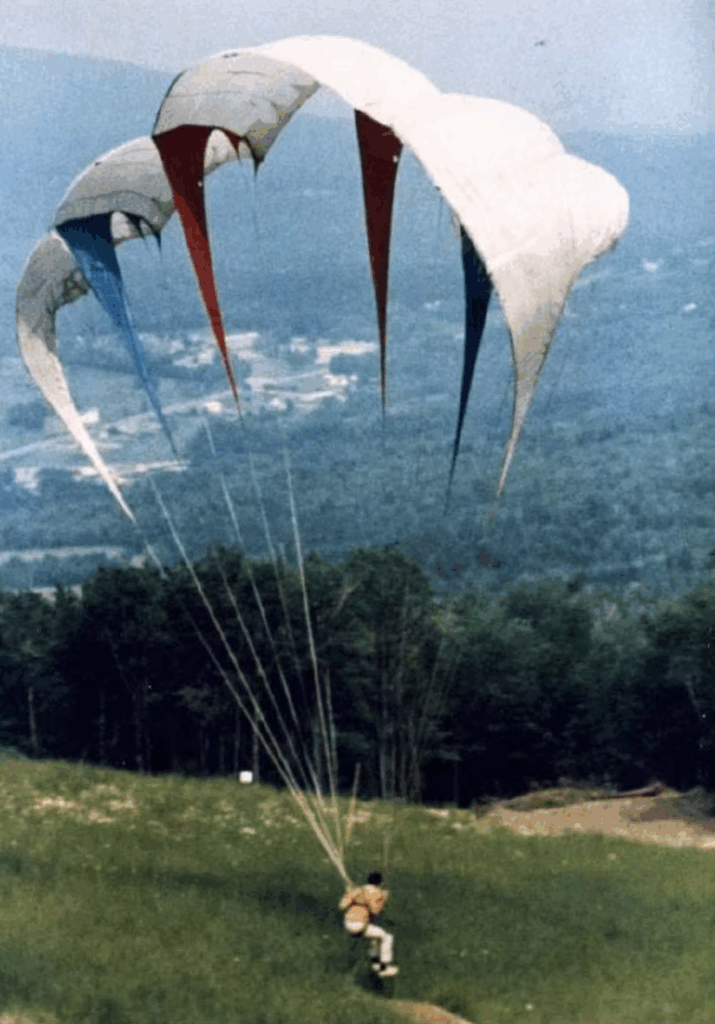
    The Birth of Paragliding (1980s). Paragliding, as we know it today, began in the late 1970s and early 1980s in the French Alps. Adventurers started using modified parachutes to descend mountains, combining hiking with flight in an informal way. Unlike hang gliders, paragliding wings were more compact and easier to carry, opening the possibility of ascending steep terrain on foot and launching from remote takeoff points. However, early paragliding equipment was cumbersome, limiting its practicality for long hikes.

    By the late 1980s, advancements in fabric technology and wing design improved the glide ratio and portability of paragliding equipment. These innovations made it increasingly popular among mountain enthusiasts who sought the thrill of free flight without the logistical challenges of hang gliding.

    The Emergence of Hike and Fly (1970s–2000s)

    • A few hard core hang gliding pilots started hiking and flying in the early 70s in Europe. With gliders as light as 12kg and glide ratios of as little as 5:1, these pioneered many new sites in Europe and around the world.
    • My first hike and fly was in 1994 in the Gregory National Park, Northern Territory Australia. My gear was 40kg, the hill only 300m and the only landing zone available was the dirt track which we drove in on and which was 1m narrower than my wingspan. This was my first taste for what I love the most which is ‘skyoneering’ – hiking and flying places never flown before..
    • As paragliding gear became lighter and more efficient in the 1990s, the concept of hike and fly began to take shape. Pilots would hike to high-altitude launch sites, carrying their wings in backpacks, and take off to explore remote landscapes. The sport appealed to adventurers seeking a combination of physical challenge and aerial exploration.

    The 2000s brought further refinements, including ultralight harnesses and wings tailored for hike-and-fly enthusiasts. Pilots began to embrace the sport as a distinct discipline, combining elements of mountaineering, endurance sports, and paragliding. Trail running and lightweight gear innovations also contributed to its rapid growth.

    The Rise of Competitive Hike and Fly (2010s)

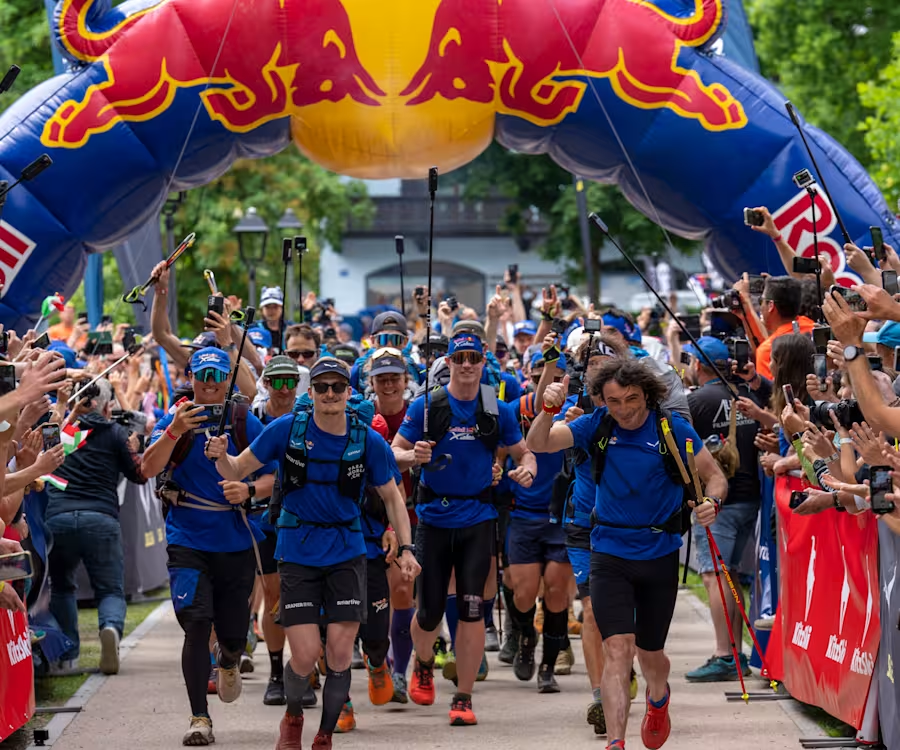
    The first formal hike-and-fly competitions began in the early 2000s, most notably with the Red Bull X-Alps in 2003. This gruelling race, covering over 1,000 kilometres across the Alps, showcased the endurance, strategy, and skill required for hike and fly. The X-Alps inspired similar events, including the X-Pyr in the Pyrenees and a growing number of regional and local races worldwide.

    Hike and Fly Today

    By the 2020s, hike and fly has grown into a globally recognized sport enjoyed by elite athletes and recreational adventurers. In 2020, with Governments prohibiting cable cars throughout most of Europe, the only way to fly was to Hike and the sport started to boom and here we are today with approximately 60 races annually around the world – and growing rapidly.

  • The Science of learning difficult things

    The Science of learning difficult things

    For most, regardless of ability, hike and fly is difficult to learn and even harder to master. The combined physical, mental and emotional hurdles that need to be overcome make it one of the hardest sports to learn – and therefore one of the most rewarding to master. Much progress has been made in recent years into understanding the science of learning and how to approach learning difficult tasks. Here are some of the highlights:

    1. Deliberate Practice

    Research: Anders Ericsson’s work, particularly in “Peak: Secrets from the New Science of Expertise” (2016), emphasizes that deliberate practice is the cornerstone of mastering difficult tasks.

    Key Insight: Focus on challenging, targeted areas where you are weakest, and practice with immediate feedback to make meaningful progress. Passive repetition is not enough.


    2. Spaced Repetition and Interleaved Practice

    Research: Benedict Carey, in “How We Learn: The Surprising Truth About When, Where, and Why It Happens” (2014), discusses how spaced repetition (revisiting material over intervals) and interleaved practice (mixing different skills or topics) improve retention.

      Key Insight: Spacing out practice allows the brain to consolidate learning, while interleaving forces the brain to adapt and recall in varied contexts.

      3. Growth Mindset

      Research: Carol Dweck’s foundational work on the growth mindset, detailed in “Mindset: The New Psychology of Success” (2006), shows that believing abilities can be developed through effort fosters persistence in learning.

      The Growth Mindset of Crigel Maurer.
      In hike and fly, errors are inevitable, and with good airmanship, they become opportunities to learn. As 8 times XAlps Champion Crigel Maurer says – ‘when you are making mistakes you are in the learning zone’.

      Key Insight: People who see failure as a stepping stone to learning are more likely to succeed at difficult tasks.

      4. The Role of Rest and Sleep

      Research: Matthew Walker, in “Why We Sleep: Unlocking the Power of Sleep and Dreams” (2017), highlights how sleep consolidates learning by strengthening neural connections made during practice.

      Key Insight: Learning happens not just during practice but also during rest. A well-rested brain retains skills and knowledge more effectively.

      5. Error-Based Learning

      Research: Daniel Kahneman, in “Thinking, Fast and Slow” (2011), explores how making and analyzing mistakes strengthens learning, provided there is constructive feedback.

      Key Insight: Learning accelerates when we understand and correct errors because it engages deeper cognitive processes.

      6. The Power of Visualization

      Research: Stephen Kosslyn and others in “The Case for Mental Imagery” (2006) have shown that

      mental practice through visualization activates the same neural pathways as physical practice.

      Key Insight: Visualizing complex tasks can enhance motor and cognitive learning, especially when combined with physical practice.

      7. Cognitive Load Theory

      Research: John Sweller’s work on cognitive load theory, summarized in “Cognitive Load Theory” (2011), shows that reducing extraneous distractions during learning allows for better focus on core tasks.

      Key Insight: Breaking tasks into smaller, manageable chunks prevents overload and improves mastery. This book will help you break down your mission into goals and then learning tasks that you can focus on one by one.

      8. Dopamine and Motivation

      Research: Andrew Huberman’s neuroscience research, discussed in his podcast and academic papers, highlights the role of dopamine in learning and motivation.

      Key Insight: Celebrating small wins triggers dopamine release, reinforcing effort and focus during challenging tasks. Formally structuring your training and recording your goals and achievements will help fuel your motivation.

      9. Active Recall and Testing Effect

      Research: Henry Roediger and Jeffrey Karpicke’s studies on the testing effect, detailed in papers like “Test-Enhanced Learning: Taking Memory Tests Improves Long-Term Retention” (2006), show that actively retrieving information improves memory and understanding.

      Key Insight: Testing yourself on learned material is more effective than re-reading or passive review. Extracting from your mind is of more benefit than insertion. Rules of thumb, checklists, acronyms are all good tools to practice recalling.

      10. Multisensory Learning

      Research: Barbara Oakley, in “A Mind for Numbers: How to Excel at Math and Science” (2014), advocates for engaging multiple senses during learning to reinforce neural connections.

      Key Insight: Combining visual, auditory, and kinesthetic learning methods enhances retention and understanding. Keep a diary in which you write out your goals and tasks – then debrief them and write down your lessons learned. If you read, speak and write out the information you will be activating four neural pathways like a four track recorder.


      Keys To Success: To learn difficult tasks effectively:Focus on;
      Deliberate and spaced practice with feedback (Ericsson, Carey)
      Develop a growth mindset (Dweck).
      Prioritize rest and sleep (Walker).
      Embrace and learn from mistakes (Kahneman).
      Use visualization and active recall (Kosslyn, Roediger). 

      You are also going to need some Grit to succeed in Hike and Fly which Angela Duckworth found to be the combination of Passion and Perseverance. Grit will be the subject of our next Blog.

    1. Finding your why in Hike and Fly

      Finding your why in Hike and Fly

      “He who has a why to live can bear almost any how.” Friedrich Nietzsche

      Understanding your purpose is crucial to achieving your goals —it’s the compass that guides your actions and decisions.

      Clarity of purpose keeps you focused, motivated, and ready to tackle whatever challenge comes your way. When you know your “why,” you’re not just training; you’re on a mission. Whether it’s a personal goal, a professional project, or even a new diet, knowing your why gives you the grit you need to push through the tough times that all meaningful endeavours inherently bring.

      And there can certainly be tough times in the sport of Hike and Fly. Whether it’s your first flight away from your training hill or pushing through rough leeside thermals in the Alps on day 14 of the Red Bull X-Alps (the world’s most gruelling adventure race), hike and fly will present tremendous challenges to you and the associated rewards that come from overcoming these challenges.

      Discovering your why

      • You have started reading this blog – why?
      • Are you interested to learn about the sport and know little about it – why are you interested in learning?
      • What makes you tick?
      • What do you want to make you tick?
      • What purpose do you currently have in your life?
      • What purpose do you seek?
      • How can Hike and Fly help you fulfil your purpose?
      • If you are Hiking and Flying already why do you seek more knowledge? Is it knowledge, skills or performance related?
      • If you do find what it is that you seek, how will it help you to achieve your purpose?

      These questions may seem esoteric to some however, knowing the answer can be powerful in helping you to achieve your goals – be they physical, mental, competition etc.

      I took up the sport because I believe that by doing hard things I develop my mental resilience which helps me in all aspects of life – from the Boardroom to the Bedroom. The healthy and competive lifestyle sets a good example to my children, ensures I am optimising my physical abilities and in turn develops my mental ones – particularly as I age. I would have read this blog as a kid based purely on the picture, because I love flying. I would pick it up now because I am always exploring ways to improve my knowledge and skill in the sport to make me safer and more competitive. With increased safety I achieve a better quality of life physically and improved competitiveness rewards my mental side by achieving tough goals.

      So ask yourselves these same questions – maybe write down the answer in your Lessons Learned Book so you can review them over time. When times get tough in the sport pull out your black book and reflect on your why – the more empowering your why the greater your grit for the sport will be. And Grit will be the subject of our next blog.

    2. Welcome to Maxvario

      Welcome to Maxvario

      Welcome to Maxvario – The destination website for the sport of hike and fly.

      The sport of Hike and Fly has grown exponentially – from only a handful of races in 2020 to over 60 races around the world in 2025 and there is no sign of it slowing down. Whilst these races are predominately in the European Alps the boom in the sport has seen races now being run across the globe from North America, South America to New Zealand. Commensurate with this growth in race numbers is the growth in our audience, equipment manufacturers, sponsors and athletes.

      The level of commitment to the sport by athletes, manufacturers and organisers has become highly professional however the sport remains disparate and distant from its potential audience- and therefore the sponsors necessary to professionalise the sport.

      MaxVario aims to build the community of hike and fly globally by connecting the audience, athletes, sponsors, manufacturers and organisers.

      Whether you are new to the sport or have won the Redbull XAlps 8 times (yes that’s you Crigel :o) there is something here for you;

      • Learn the basics through our online Hike and Fly skills blog;
      • Stay up to date with the latest Hike and Fly gear;
      • Maximising your FAI points and plan your racing season with our global hike and fly race calendar;
      • Develop your skills and capabilities with our training blog; and
      • Keep up to date with the race scene including new races, race dates, registration cutoffs, race results and race reports.

      So if Hike and Fly is your thing (or you think it could be) then welcome….you are in the right place. Subscribe here and we look forward to keeping you up to date.